Q. 2: Ought everyone to believe there is a God?
A. Everyone ought to believe there is a God; and it is their great sin and folly who do not.
Hebrews 11:6; Psalm 14:1
Q. 2: Ought everyone to believe there is a God?
A. Everyone ought to believe there is a God; and it is their great sin and folly who do not.
Hebrews 11:6; Psalm 14:1
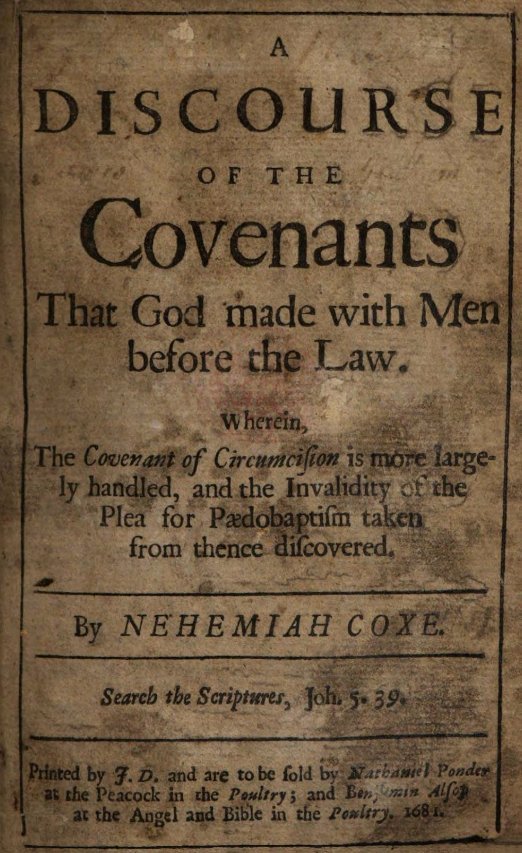
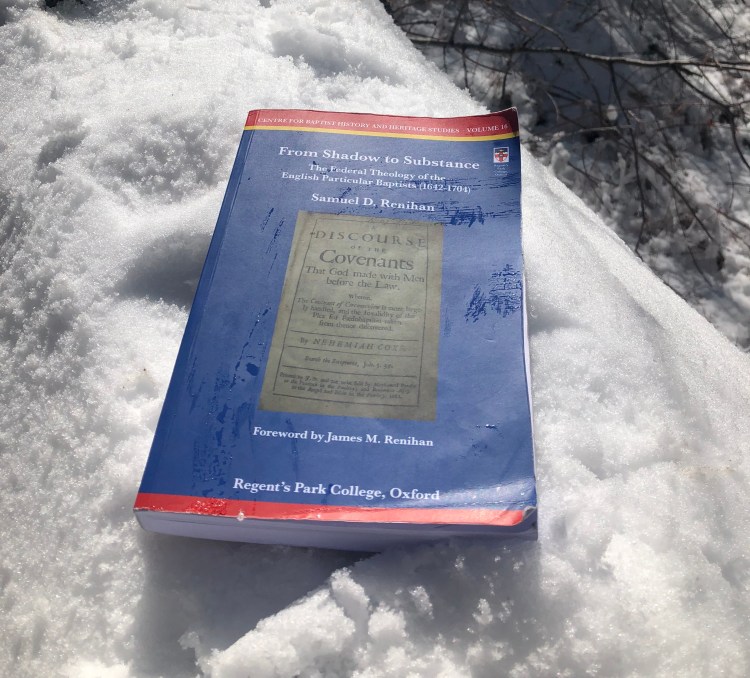
In chapter 7 of From Shadow to Substance, Samuel Renihan provides us with the Covenant Theology of 17th Century Particular Baptist Nehemiah Coxe.
Coxe, like many Particular Baptists before him, seen Gods dealings with Abraham differently than that of his Paedobaptist brethren. Coxe seen in Genesis 12 the Covenant of Grace being revealed to Abraham just as it was to Adam and Eve in the garden. Coxe says that the Covenant of Grace…
“…was the same for substance, that had been more darkly revealed in the ages before, but it pleased God to transact it with him as he had not done with any before him.”
Not only was it more clearly revealed to Abraham than before, but Coxe, like many Particular Baptists before him seen the two-fold nature of his seed that had belonged to two distinct Covenants…
“Abraham is to be considered in a double Capacity, both as the Father of all true Believers, and as the Father and Root of the Israelitish Nation, and for both these Seeds God did enter into Covenant with him; howbeit these Seeds being formally distinguisht the one from the other, their Covenant Interest must of necessity be diverse, and fall under a distinct Consideration; and the Blessings appropriate to either, must be conveyed in a way agreeable to their peculiar and respective Covenant-Interest.”
Concerning Nehemiah Coxes’ A Discourse of the Covenants (pictured above), Dr. Renihan says of Coxe…
“Coxe’s method for the remainder of the book was to distinguish and relate these two seeds and their respective covenants. He dedicated a section to the covenant of grace as revealed to Abraham, another to the covenant of circumcision given to Abraham, and a final section to the relationship between the two.”
This is an important distinction in the federal theology of the Particular Baptists. If you would like to learn more about this distinction, or perhaps, would like to challenge your own traditon I encourage you to read From Shadow to Substance.
Covenant Theology does not = Infant Baptism/every Covenant a different admin. of the Covenant of Grace. There’s another option…
https://www.amazon.com/Shadow-Substance-Theology-Particular-1642-1704/dp/1907600310
Q. 1: Who is the first and chiefest being?
A. God is the first and chiefest being.
Isaiah 44:6; 48:12; Psalm 97:9
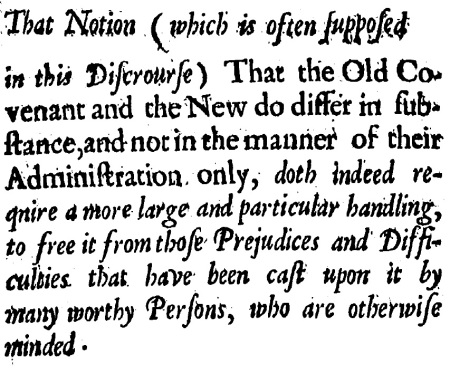
The Covenant Theology of Nehemiah Coxe is featured in chapter 7 of Samuel Renihan’s book From Shadow to Substance. Below are a few quotes taken from this chapter which provide some clarity concerning the differences between a Particular Baptist view of the Covenants, and the common Paedobaptist view of Coxes’ day.
As noted in the above picture, Coxe had a desire to devote more time to the Old Covenant and how it differed from the New. However, Coxe found no need to explain this as Dr. John Owen had already answered this in the 3rd Vol. of his Exposition of Hebrews. As Samuel Renihan says, “…Coxe referred the reader to Owen and left it at that.”
“I found my Labour for the clearing and asserting of that Point, happily prevented by the coming forth of Dr. Owen’s 3rd Vol. upon the Hebrews, where it is largely discoursed, and the Objections that seem to lie against it, fully answered…whither I now refer my Reader for Satisfaction about it, which he will there find answerable to what might be expected from so great and learned a Person.”
On how the Old and New Covenants could not be the same due to better promises…
“…if one covenant be established upon better promises…then another, it is from thence denominated, and for that reason to be esteemed a better covenant then the other.”
On federal headship, and how the only way one could belong to a given covenant was through that federal head. Samuel Renihan says,
“Thus it was, Coxe argued, for Adam, Noah, and Abraham. And so it is with Christ.”
Christ is the federal head of the New Covenant. Therefore, Coxe says,
“It is by union to him that Believers obtain a new-Covenant-interest.”
Coxe describes the Covenant of Works that Adam broke, and the result of this fall for him and his posterity. Wait, what? The Particular Baptists believed in a Covenant of Works? 😉
”In this condition Man was…utterly disabled to stand before God upon Terms of a Covenant of Works, and as uncapable to bring himself upon other Terms with God; for he was not able to move one step towards a Reconciliation with God.”
On the Covenant of Grace being made known in the curse pronounced on Satan in Genesis 3:15…
“In the Sentence passed upon the Serpent…there was couched a blessed Promise of Redemption…which Salvation thus promised, Man was to receive by Faith.”
In chapter 7, Dr. Renihan provides a systematic description of Coxe and his theology. The chapter unfolds with these headings:
*Introduction to Coxe *Of Covenant-Relation to God in General *The Covenant of Works, *The Covenant of Redemption and the Covenant of Grace *The Noahic Covenant *The Covenant of Grace revealed to Abraham *The Covenant of Circumcision *Of the Mutual Respect of the Promises Made to Abraham *Conclusion.
If you’re interested in learning more about the founding, history, and theology of the Particular Baptists, I encourage you to read this book. What you will find is that while Reformed Theology does = Covenant Theology, Covenant Theology does not = Infant Baptism. There’s another option…
“From the beginning, the covenants of works and grace involved two contradistinguished groups of people, fallen man and redeemed man. The strength of this argument rested on Coxe’s supporting assertions. None could escape the curse of the covenant of works unless God placed them in a new covenant, and none could claim a place in the mediatorial work of Christ except those who had been promised to the Son in the covenant of redemption and who had believed in the promise of salvation in the covenant of grace.”
~ Samuel Renihan
https://www.amazon.com/Shadow-Substance-Theology-Particular-1642-1704/dp/1907600310
As a Reformed Baptist, I have often been called a Dispensationalist because of the manner in which my tradition views Gods Covenants with man. Being covenantal in my theology, being referred to in this way is not seen as a positive thing. Now don’t get me wrong, I sincerely love my Dispensational brothers and sisters in Christ. But after growing up a dispensationalist, that is not a system that I continue to believe is consistent with all of scripture.
This video is not implying that Dr. R.Scott Clark is a Dispensationalist. We all know better than that. What it does reveal is a glaring inconsistency in the way Dr. Clark defends the infant baptism tradition.

“Owen’s ongoing clarification of covenant theology and his enduring commitment to a visible saints ecclesiology meant that this was a practice which was increasingly out of step with his presuppositions, and increasingly lacking in theological rationale.”
“Absolutely under the Old Testament, it consisted only in Promise, and as such only is proposed in the Scripture, Acts 2.39. Hebrews 6.14, 15, 16. The Apostle indeed says, that the Covenant was confirmed of God in Christ; before the giving of the Law, Gal. 3.17. And so it was not absolutely in itself, but in the Promise and Benefits of it. The nomethesia, or full legal establishment of it, whence it became formally a Covenant unto the whole Church, was future only, and a Promise under the Old Testament.”
“It wanted its solemn confirmation and establishment by the blood of the only Sacrifice which belonged unto it. Before this was done in the death of Christ, it had not the formal nature of a Covenanl or a Testament, as our Apostle proves, Chap. 9.15-23.”
“[The new covenant] is neither a Renovation of [the old] Covenant, nor a Reformation of it, but utterly of another nature, by whose introduction and establishment that other was to be abolished, abrogated and taken away, with all the Divine Worship and Service which was peculiar thereunto.”
~ John Owen
via Samuel Renihan’s From Shadow to Substance
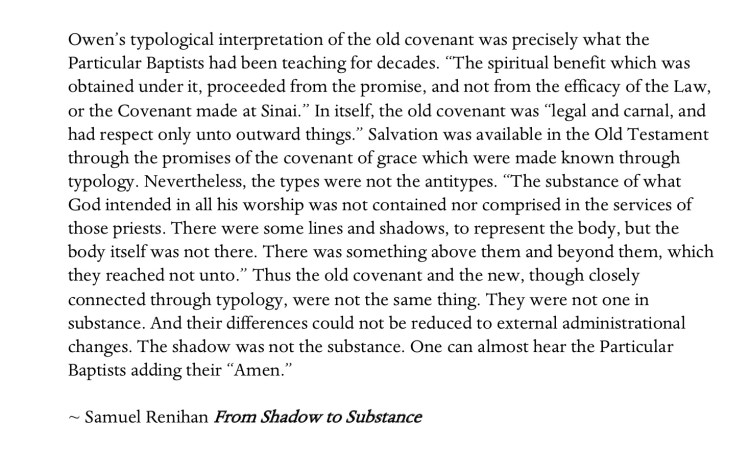
Below is a quote from Samuel Renihan’s new book From Shadow to Substance.
Dr. Renihan shows why Particular Baptists appealed to Dr. Owens work in the 17th Century, and why they continue to do so today.
We know Dr. Owen was not a Baptist. Our point is that he often spoke like one.

I will be sharing several posts by a fellow Particular Baptist, Dr. Sam Renihan.
Dr. Renihan has recently provided clarity in a place where most often leave clutter and confusion. Many trained minds today approach history by making assumptions rather than providing any actual historical data. Often we see them take a “trust me” approach to history, which allows them to draw straight lines through history when in fact the lines are actually a bit wavy.
Dr. Renihan is attempting to “engage” with this tension, with an approach that allows the historical data to speak for itself and the reader to study the history of these Particular Baptists for themselves.
In other words, Dr. Renihan doesn’t tell us what the history is, he gives it to us. This is is very refreshing indeed…
Here is a link to Dr. Renihan’s latest blog entry.
https://pettyfrance.wordpress.com/2018/03/21/lost-presbyterian-lenses/

I remember it as if it were yesterday. I was in college attending a Principles of Preaching class being taught by a very respected local pastor, and Dean of the Graduate School of Theology. The class was structured in a way that would teach the students about the history of preaching, the styles of preaching, and the goal of preaching. I won’t go into too much detail here as to why we studied men named Rob Bell and Andy Stanley in this class. I will speak much about these things in my ongoing series discussing the last several years of my life, found here.
In this class was a group of students from a wide variety of backgrounds, denominations, and personal callings. I mention calling because if one was attending a preaching class, the chances of you actually wanting to preach were very high. We knew that during this class we would each preach three sermons on a passage of scripture given to us by the professor. It was during our first sermon where a student walked up in front of the class to present his own on 1 Samuel 17. Yes, the famous story of David and Goliath was about to be preached to us and every student was eager to hear how this student was going to approach this passage.
As soon as he began to speak I realized immediately that he was in trouble. You see, for the following 30 minutes what proceeded from his lips was no sermon at all. Rather, what we heard was a story concerning all of the challenges this student had faced throughout his life. The story of David and Goliath quickly turned into a story that was all about him. So why would this student approach scripture in this way? Why would this aspiring preacher insert himself into the scriptures, turning a historic event given to us by the Creator Himself into him overcoming his personal life struggles? I think the answer was because he didn’t know any better.
A faulty theology often leads people to this kind of conclusion. They approach Gods inspired word through a lens of me, myself, and I. It’s not that this young man was purposely trying to twist scripture in a way it was never intended. He was very passionate, loving, and shared a heartbreaking story of how he was bullied throughout his life. He was often abused by loved ones and was told consistently that he would never amount to anything. Now, here he was in a university classroom preaching Gods word to a bunch of like-minded brothers and sisters. I don’t blame him for being on an emotional high due to the things God has done throughout his life. But despite the passion he displayed throughout his story or the clarity with which he spoke concerning what took place in that passage, he still turned Gods story into his own and revealed a view of the scriptures that is common in many evangelical churches today.
How often we forget that the Bible is the unfolding story of Gods redeeming work throughout history. Since creation, the Almighty God is calling a people to Himself, renewing them by the power of the Holy Spirit, and applying to them the righteousness of Christ.
That is why his faith was “counted to him as righteousness.” But the words “it was counted to him” were not written for his sake alone, but for ours also. It will be counted to us who believe in him who raised from the dead Jesus our Lord, who was delivered up for our trespasses and raised for our justification.
Romans 4:22-25
How often we fail to remember that the story isn’t about us, but rather, an even better story where Jesus is the main character and not ourselves.
Jesus Himself explained this very clearly. And beginning with Moses and all the Prophets, he interpreted to them in all the Scriptures the things concerning himself.
Luke 24:27
How easy is it for a preacher to turn the story of Gods redeeming work into a self-help seminar, where God is in the background of our own unfolding drama? Walk into many evangelical churches on The Lords Day. You will find this kind of thing taking place on a consistent basis, turning the scriptures into a book of good advice and making man the hero of the story. Where scripture speaks clearly concerning the problem of sin and Gods victory over that same sin, we often flip the script to something that’s all about ourselves, and then give God a shout out immediately following. This is a tremendous problem that is ultimately robbing God of His glory, and giving that glory to man even though the scriptures say otherwise. And again, we attach Gods name at the end of it as if somehow that is making up for us taking credit for His finished work.
I am the LORD; that is my name; my glory I give to no other…
Isaiah 42:8
While I can spend much time on this topic, I promise that my objective is not to pick on a fellow student of mine. What I want to remind people of is that this sort of thing does not just happen in a university preaching class, or even on any given Sunday at a church near you. It happens in our conversations with fellow believers, which includes social media like Twitter and Facebook. Here, we see the works of cults like the Hebrew Israelites taking the blessings and curses of Deuteronomy 28, inserting themselves into the passage and producing a radical theology that is all their own. But what can be just as dangerous is when a Christain does the same thing by making themselves David, their life problems Goliath, and replacing the same blessings and curses mentioned above into every thought, desire, or circumstance that comes to mind. The actions of a cult and those of a Christian are obviously different, but the conclusion of both result in the same thing; a faulty theology.
So what can we do to combat this? What can we do to stop turning the scriptures upside-down and start honoring God the way we are called to? We must come to realize that it’s not all about you. The scriptures are Gods story and not our own. When we consistently place man at the center of the universe, what naturally results is a faulty theology that gives man a reason to boast. This is the exact opposite of what the scriptures proclaim, and that is that no one will boast. When we are in glory one day with our creator, we will not be bragging about how many things we were able to overcome in the name of Jesus. We will not be discussing our own stories of victory, and how God was a supporting actor in our story. We will be worshipping the creator, the perfect one, the One whom the scriptures proclaim from Genesis to Revelation.
We should now delight in the faith we have, knowing that the faith itself was a gift given to us by God.
For by grace you have been saved through faith. And this is not your own doing; it is the gift of God, not a result of works, so that no one may boast.
Ephesians 2:8-9
We didn’t do anything to deserve this gift, and if you would just stop and think it through for a second you would come to realize that the scriptures teach the opposite. We actually deserve Gods wrath for our sin. He found us when we were not looking for Him (Isaiah 65:1), and when we were dead in our trespasses and sins.
And you were dead in the trespasses and sins in which you once walked, following the course of this world, following the prince of the power of the air, the spirit that is now at work in the sons of disobedience— among whom we all once lived in the passions of our flesh, carrying out the desires of the body and the mind, and were by nature children of wrath, like the rest of mankind.
Ephesians 2:1-3
We need to pull the focus from ourselves and place it back where it belongs, which is on Christ alone. When we view the scriptures through a lens that places God at the center of everything and not ourselves, we can truly appreciate the great stories of the Bible for what they truly are, a story about Jesus. We can read Ephesians 2:1-3 in light of what immediately follows in verses 4-7.
But God, being rich in mercy, because of the great love with which he loved us, even when we were dead in our trespasses, made us alive together with Christ—by grace you have been saved— and raised us up with him and seated us with him in the heavenly places in Christ Jesus, so that in the coming ages he might show the immeasurable riches of his grace in kindness toward us in Christ Jesus.
We can read about the heroes of faith in Hebrews chapter 11, in light of what immediately proceeds it in chapter 12. Realizing that it’s not the people in these stories that give us hope. Neither is it placing ourselves into these individual stories. What’s important is the perfector of their faith.
Therefore, since we are surrounded by so great a cloud of witnesses, let us also lay aside every weight, and sin which clings so closely, and let us run with endurance the race that is set before us, looking to Jesus, the founder and perfecter of our faith, who for the joy that was set before him endured the cross, despising the shame, and is seated at the right hand of the throne of God.
Hebrews 12:1-2
Perhaps, the best way we can counter this superficial reading of the scriptures is to be transformed by the scriptures themselves. Reading every word with one eye on the text, and the other on Christ. When we start seeing the many stories of the Bible not as things we have to overcome ourselves but revealing to us what the Christ has already overcome for us. The story is much bigger, better, and richer than anything you can ever come up with yourself. It is a story not our own, but a story where we can find ourselves with God at the center, and His love for the ones He has given to the Son as the result and not the primary focus.
If what I have stated in this article offends you in any way, or if what I have said is equivalent to me throwing a grenade in the middle of your theological foundation, I encourage you to search the scriptures to see that it is so. Don’t take offense, but rather, try seeing the thing behind the thing. Or as we used to say in the Marine Corps, try “peeling that onion back some” to get the bigger picture. When you do, my hope is that you start to see the scriptures as they were intended to be seen, and not as fairy tale examples where we must insert ourselves into a place we had no business. I will leave you with a quote from pastor Alistair Begg that encouraged me to write this article.
“We go wrong when we attend church and always ask, ‘I wonder where I am in this sermon?’ The real question is, ‘I wonder where Jesus is in this sermon?'”
The Bible is not about you. But this is good news indeed!

 rruiz0369