Excuse Me Sir, Are You Sure You’re in the Right Place?

F644680E-8004-4A46-A200-ABA1654BAB89


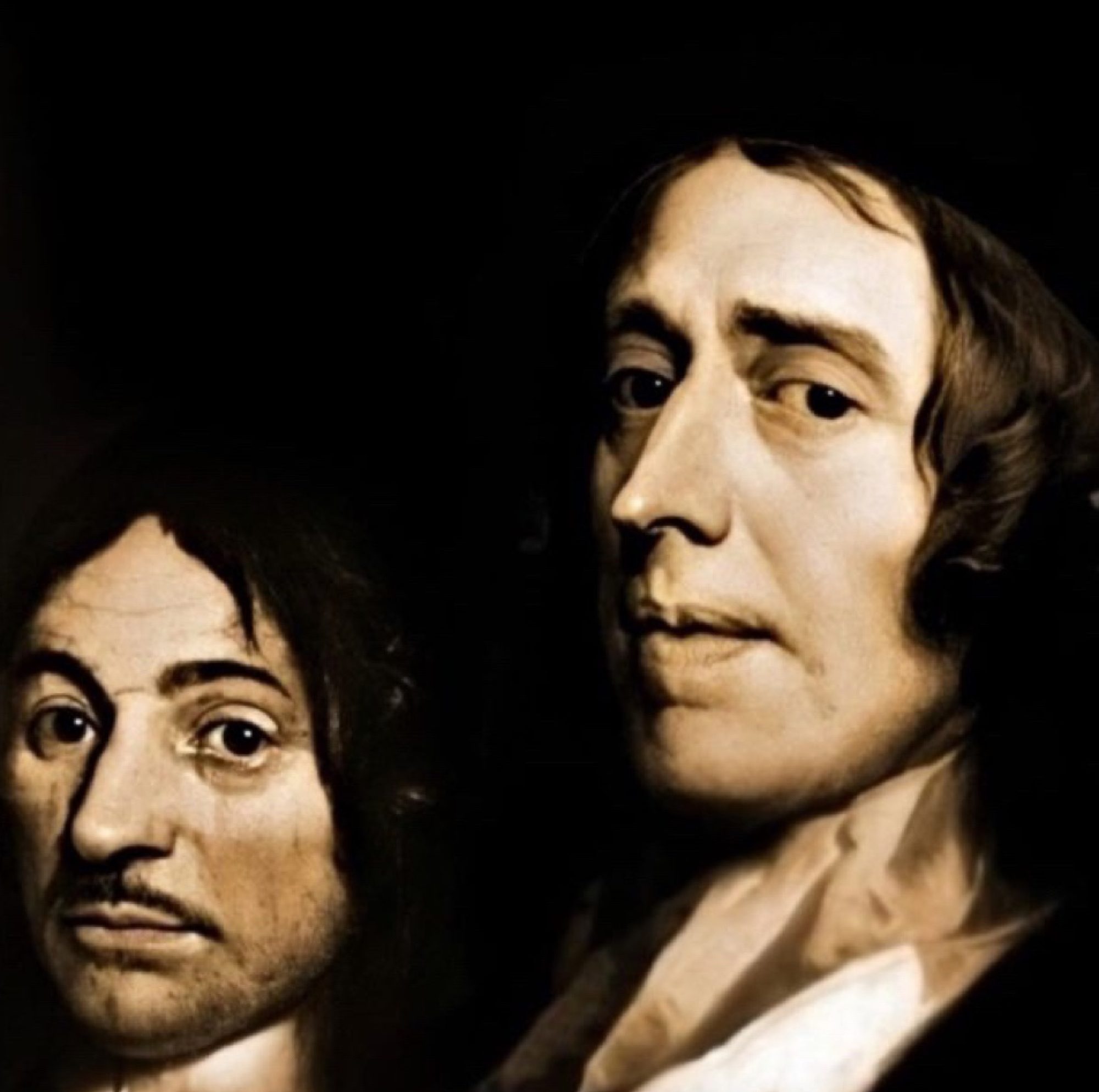
A quick summary of Dr. Matthew Bingham speaking at the recent Renewing the Present With Help From the Past Conference sponsored by the new Institute of Reformed Baptist Studies Seminary. IRBS will be opened this Fall in Mansfield, Texas.

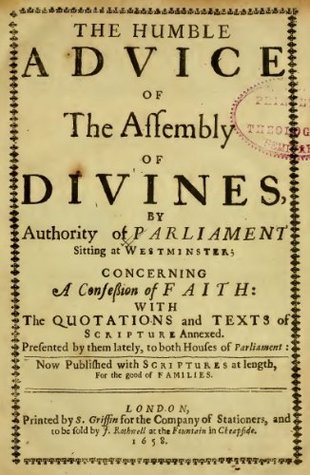
I’ve found that the most vocal in defending who has a seat at the Reformed table and who does not, would likely find themselves on the outside looking in when compared to the Reformers themselves.


1689 Federalism vs Westminster Federalism?

9506A6CF-212A-482A-B25C-D71B3A02F677


I enjoyed listening to a good podcast last night where two different podcasts joined forces for an evening of Covenant Theology.

Justin and Brandon of The Two Thieves podcast joined Dale and Drew of the According to Christ podcast for an ongoing discussion of 1689 Federalism, and contrasting it with Westminster Federalism. If you enjoy Covenant Theology and would like to listen to some frequently asked questions concerning the different Reformed Confessions this episode will be very helpful.

Just a few of the questions discussed in this podcast include:

What is a covenant?

What is the Covenant of Grace?

How is the Covenant of Grace administered in the Old Covenant?

How were Old Testament saints saved compared to Christians today?

Does 1689 Federalism believe in the Covenant of Works?

Was the Mosaic Covenant the Covenant of Works?

Were all the O.T. Covenants the Covenant of Grace?

Whether a convicted Paedobaptist or a hard core Baptist, challenging your position can only strengthen your beliefs or reveal some cracks in your tradition.

Podcast link is here! 👇🏽

https://accordingtochrist.com/2018/04/26/ep-26-articulating-1689-federalism-on-two-thieves-podcast/


“2,000 Years!”

4905AF2B-4949-462F-8E07-02735DC798EF

As I began my study into Covenant Theology, I was often reminded of the “2,000 years” argument from my P&R brethren.

Some background…

Upon leaving the Marine Corps in 2013, I soon found myself sitting in a classroom at a liberal Christian University, and a pastor at a seeker-sensitive church in Southern California. After growing up in the Calvary Chapel movement my background was heavily shaped by a theological tradition known as Arminianism. Although, if you had called me an Arminian at the time I would likely have had no idea what you were talking about. As I continued to read my Bible and study many theologians, I grew convicted by the inconsistencies in both the university I attended as well as the local church I served in. It was during this time that by His Grace I had come to embrace the Doctrines of Grace.

But I didn’t stop there. Frustrated with the Calvinistic-Charasmatic movement I had become a part of, I decided to move forward on a journey that would help me sift through all the groups that were claiming to be Reformed, and get to the ones who actually had a seat at the Reformed table. It was at the beginning of this journey where the “2,000 years” screams became louder and more consistent.

Back to Covenant Theology…

On the beginning of my journey I would often be told that a theology would only truly be Reformed if it resulted in the practice of infant baptism. Many of the people saying these things were fellow Christians I had much respect for, and still do so today. There were many Christians on social media from other Christian churches who were eager to pass down the tradition they had already embraced. As I mentioned earlier, the screams were getting louder so my study into the early church fathers was about to get serious.

So this is where Baptism in the Early Church comes in. It is a book written by two professors who specialize in the field of Patristic Studies. Combined, prof. Stander and prof. Louw have written over 500 books, and articles. But what really got me interested in this book was that both professors were members of paedobaptist churches. James Renihan mentions this in the foreward…

“The authors, two internationally known and highly regarded classical scholars, members of paedobaptist churches, present a dispassionate examination of the problem, based on a careful treatment of primary sources.”

As a pastor and student, I had been lucky to have in my possession a Logos library that contained the complete works of the early church fathers. I was able to examine the “2,000 year” argument in the primary sources themselves, and do so concurrently with this book. So Baptism in the Early Church served as a tool to guide me through the original sources themselves. If you haven’t figured it out by now, the “2,000 year” argument I am referring to is the argument that infant baptism has been the norm in the church for 2,000 years.

After reading this book (as well as the original sources themselves), I feel this claim has been put to rest. The method of baptism, which includes the who, what, when, where, why, and how, has not been the same for 2,000 years, and those claiming otherwise should give this book a read as it will challenge that position. This book has been tough to track down for some, with the price varying from $85.00, down to about $35.00 from third party sellers.

https://www.amazon.com/gp/offer-listing/0952791315

 Regardless of the price, this book has been a tool I return to often.
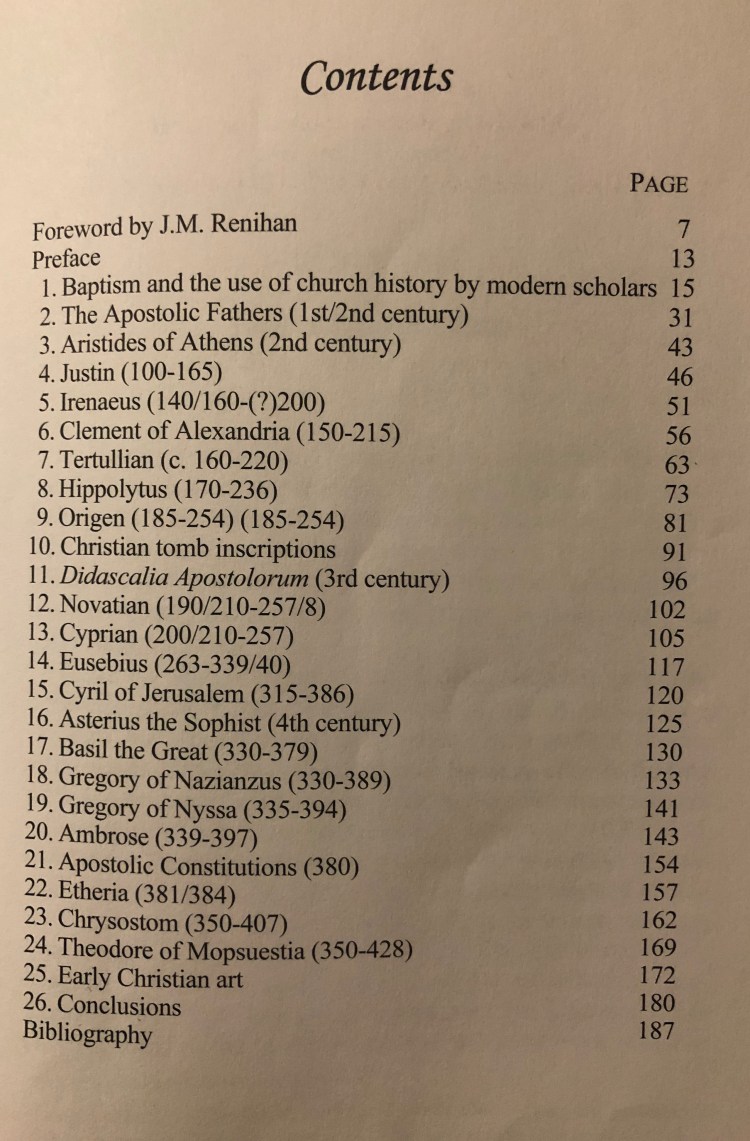
image.jpg

Pink and “The Divine Covenants”

8B245535-C84C-4062-923B-5061464E6977


Pink concerning the election of Abraham…

“There was nothing whatever, then, in the object of the divine choice to commend him unto God, nothing in Abraham that merited His esteem. No, the cause of election is always to be traced to the discriminating will of God; for election itself is ‘of Grace’ (Rom. 11:5) and therefore it depends in no wise upon any worthiness in the object, either present or foreseen. If it did, it would not be ‘of grace.’

That it was not at all a matter of any goodness or fitness in Abraham which moved the Lord to single him out to be the special object of His high favor is further seen from Isaiah 51:1, 2: ‘Look unto the rock whence ye are hewn, and to the hole of the pit whence ye are digged. Look unto Abraham your father, and unto Sarah that bare you.’

While it be true that God never acts capriciously or at random, nor arbitrarily—that is, without some wise and good reason for what He does—yet the spring of all His actions is His own sovereign pleasure.”


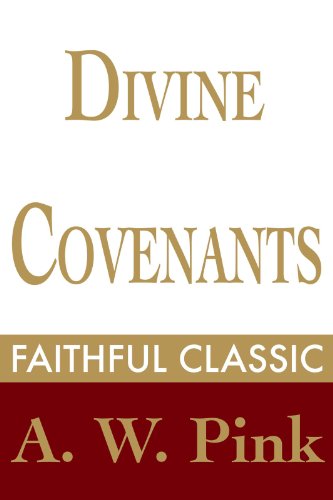
A friend of mine has been reading The Divine Covenants by A.W. Pink. As he often quotes from this book, it reminds me daily of how this book has sat in my library for years being referenced on occasion but never read cover to cover.

The Divine Covenants has been recommended by top scholars as it provides an overview of the various covenants given to us in the scriptures. Listed below is the Table of Contents for the book.

I found this book on Amazon here: https://www.amazon.com/Divine-Covenants-Arthur-W-Pink/dp/0997439238

The paperback version is going for $14.99, and you can even purchase it via Kindle (never heard of her) for only $0.99.

Table of Contents:

Chapter 1. The Everlasting Covenant

Capter 2. The Adamic Covenant 

Chapter 3. The Noahic Covenant

Chapter 4. The Abrahamic Covenant 

Chapter 5. The Sinaitic Covenant 

Chapter 6. The Davidic Covenant 

Chapter 7. The Messianic Covenant 

Chapter 8. The Covenant Allegory 


“God’s Foreknowledge Cannot Mean Foreseeing.”

E31FBBD5-8256-4643-BA85-296BC24E67C1


Vos, commenting on Romans 8:28-29 says:

“Now one may wonder whether anything still remains of this beautiful argument and this natural tie, if one is forced to give “foreknowledge” the meaning of “foreseeing.” Then everything becomes unintelligible and artificial. The divine act that stands at the beginning of the entire sequence then becomes something dependent and is no longer fit to be the basis, firm in itself, of the rest. We have a root that must draw its sap from the trunk and branches and at the same time must still also guarantee that trunk and branches will not wither—a contradiction.”

~ Geerhardus Vos (Reformed Dogmatics 1.5)

J.C. Ryle on John 6:37…

10AF9BBD-FE16-4907-8154-C4361F17617B

“We learn from these words the great and deep truth of God’s election and appointment to eternal life of a people out of this world. The Father from all eternity has given to the Son a people to be His own peculiar people. The saints are given to Christ by the Father as a flock, which Christ undertakes to save completely, and to present complete at the last day. (See John 17:2, 6, 9, 11, 12; and 18:9.) However wicked men may abuse this doctrine, it is full of comfort to a humble believer. He did not begin the work of his salvation. He was given to Christ by the Father, by an everlasting covenant.”

~ J.C. Ryle   (Expository Thoughts on John v.1)

R.Scott Clark, The Reformed Confession(s), and The Time Machine Test…

A041D139-6048-4143-B0FB-E59AB1440EE0

Dr. Matthew Bingham, who is a pastor and a current professor at Oak Hill College in London, gave a tremendous presentation this morning at the Renewing the Present With Help From the Past Conference that took place in London. The conference is sponsored by the new Institute of Reformed Baptist Studies (IRBS) Theological Seminary that’s due to open this Fall in Mansfield, Texas.

Dr. Bingham held nothing back during his lecture, choosing to mention the outspoken (in my opinion) R.Scott Clark of Westminster Seminary, Ca., by name. Dr. Clark is a church history professor who has taken a bulldog approach (in my opinion) towards those who would use the term “Reformed Baptist” to describe themselves.

Professor Bingham calls out some inconsistencies in Dr. Clark’s arguments, including using Dr. Clark’s own argument, which professor Bingham refers to as the “Time Machine Test” against him. Dr. Bingham also brings to light infant baptism and its relation to a national church, and points out how Dr. Clark might also be on the outside looking in when applying his own standards (The Time Machine Test) to himself. It’s an amazing presentation, indeed.

Dr. Bingham with grace and clarity defends the term “Reformed Baptist” providing it’s proper definition today, while showing us what it meant yesterday (17th Century). I encourage you to watch the video below. Dr. Bingham opens up the conference around the 13-minute mark.


The Covenant Theology of Nehemiah Coxe p.3…

75C6CA46-31E9-4E4B-901B-B699A4650AF8


In chapter 7 of From Shadow to Substance, Dr. Renihan points out an important distinction in the covenant theology of Nehemiah Coxe. Concerning Nehemiah Coxes’ book (A Discourse of the Covenants) much is dedicated to the Abrahamic Covenant. More specifically, the dealings with Abraham’s natural offspring within this covenant, the sealing of the covenant of circumcision in Genesis 17 that had been developing for many years prior, as well as the “foundation of the Mosaic covenant in years to follow.”

“Beginning in Genesis 12, Coxe pointed out that alongside of the heavenly promises of the covenant of grace God gave an earthly promise to Abraham, the multiplication of his offspring. In Genesis 13:14-17 God added the promise of a fruitful land in which the multiplied offspring would dwell. Expanding on this promise in Genesis 12 and 13, Coxe drew attention to God’s oath to Abraham in Genesis 15 that his descendants would surely inherit the land of Canaan. He pointed out that ‘these things are expressly said to have been transacted in a way of Covenant with Abraham.’ Coxe was building a case that God’s covenantal dealings with Abraham were progressive, and one must take them all into account to get a complete picture of the covenant in view.”

I placed an emphasis on the word “progressive” in this passage, as this is something that in my experience my Paedobaptist friends struggle to deal with.

Dr. Renihan continues…

“At last Coxe arrived at Genesis 17, the ‘hinge of the controversy.’ Referencing Acts 7:8, he consistently referred to this covenant as the covenant of circumcision, explaining this name to mean ‘that Covenant of which Circumcision was the Sign or Token; or that Covenant in which a Restipulation was required by the Observation of this Rite.’ Here Coxe noted that whereas God had primarily covenanted promises to Abraham thus far, here ‘we first meet with an express Injunction of Obedience to a Command (and that of positive Right) as the Condition of Covenant Interest.’ Though God vouchsafed ‘for the Ensurance of the Promises…a strict and intire Obedience to his Precepts is required in order to the Inheritance of the good things that were to be given by this Covenant.’”

The covenant of circumcision and the covenant of grace promised to Abraham are important factors in the federal theology of the Particular Baptists. Missing out on the distinctions between the two, namely the covenant of works that the covenant of circumcision was (failure to comply with the command of circumcision would result in disinheritance), and the covenant of grace that existed in promise form (not turning the Abrahamic Covenant into the actual covenant of grace), ultimately lead to a faulty view of the covenant made with Abraham.

If you want to read more about the Covenant Theology of the Particular Baptists I encourage you to check out this excellent work.

https://www.amazon.com/Shadow-Substance-Theology-Particular-1642-1704/dp/1907600310