It’s always important to know who is teaching you your church history. Throughout the years I have been witness to many church history professors who get this wrong…
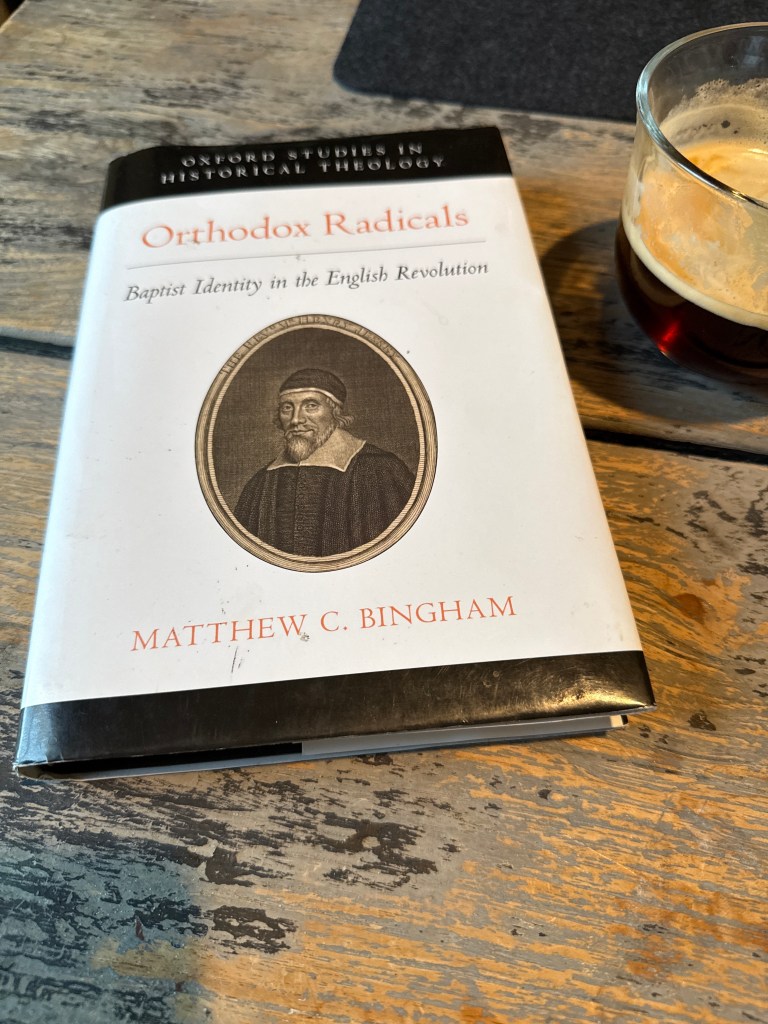
“General Bapists thus understood their soteriological convictions to be definicional aspects of their religious identity. To deny foundational Arminian doctrines such as Christ’s universal atonement was, as the General Baptist William Jeffrey put it, to make ‘the Gospel… the tender of a lie, which is blasphemy to affirme.’ Particular Baptists, in turn, also placed unity on soteriological points ahead of unity on baptism. Many Particular Baptists who would not hesitate to ally themselves in a variety of contexts with paedobaptistic congregationalists, would nonetheless recoil from promoters of Arminianism, whether baptistic or not. Arminianism was an ‘opinion [which] much oppresseth and disturbs the godly’ and its champions were those ‘who under pretence of seeking truth, doe by cunning and craftie enquiries undermine the same, and….. overthrow the faith of some.’ Although many people in mid-seventeenth-century England were drawing similar conclusions about baptism, this agreement was dwarfed by disagreement over soteriology. Sacramental concord did not necessarily create a sense of collective identity or unite them all in an imagined Baptist community, and these conclusions should caution against the use of any linguistic formulation that would imply as much.
Unfortunately, however, such caution has not always been shown, and the anachronistic use of the denominational label ‘Baptist’ has created a curious phenomenon within the historiography: scholars simultaneously speak of seventeenth-century Baptists as though they were a coherent entity, while at the same time recognizing that in practice, the General Baptists and Particular Baptists had no more interaction than any other two randomly selected English sects. There is basic agreement that, at a minimum, by 1644, the General and Particular Baptists were wholly distinct movements. B. R. White explains that ‘they consistently organized separately, differed in their views of intercongregational relationships and the ministry, and, on the whole, flourished in different parts of the country.’ Likewise, lan Birch notes helpfully that ‘the two groups developed separately and independently throughout the period’ and ‘had little to do with each other.’
And yet, despite this widespread recognition, authors will continue to speak of a common ‘Baptist cause,’ reference the ‘Baptist position’ on doctrinal controversies, and generally muddle two movements that, by common consent. were almost entirely distinct.’”
 rruiz0369